Live Better
When Your Back Is Against the Wall, Think!
When pressure turns into survival mode, hunger can make you move. But without strategy, it can also make you waste energy in the wrong battle. A reflection on Sun Tzu, Hannibal, mindset, and the quality of the next decision.
A friend recently said something that has stayed with me, and made me uncomfortable.
He is middle-aged, skilled, and naturally entrepreneurial, stuck in a job that does not reflect his potential, earning less than his outgoings with no obvious route upward through employment. I want to acknowledge, without dwelling on it here, that when capable and experienced people are systematically passed over, it accumulates year on year, quietly and without ceremony, until it stops feeling like frustration and starts feeling like fact. That deserves naming plainly.
My friend does not believe in positive thinking, or in maps of the mind or models of behaviour, and to him, that kind of language belongs entirely to people with options.
"My back is against the wall," he said. "I'm going to war."
And I understood him completely. When life has cornered you, and there is no safety net, no family cavalry, no friend with a cheque book, going to war is one of your only viable options. Optimism can sound insulting, and the language of mindset can feel like advice delivered from solid ground to someone standing in quicksand.
He is not wrong to be in a fight, because he has read his situation correctly. The question is only whether his weapons match his terrain.
Hunger Is Real
Sun Tzu opens The Art of War writing that war is a matter of life and death, safety and ruin, and that it must be studied carefully. He is not romanticising the fight but insisting that the stakes be taken seriously, and that insistence begins with acknowledging the pressure that drives a man into battle in the first place.
My friend is under that pressure. His earnings fall short of his outgoings, the conventional options are narrowing, and the ceiling above him in employment has been quietly enforced by forces that few will openly name. The conventional assumption is that fewer options produce fewer outcomes, but the opposite is often true. When the comfortable exits close, the uncomfortable ones become visible for the first time, and my friend has started walking through one.
Many people in his position retreat, managing the decline and waiting for circumstances to improve on their own, but he has decided they will not, and that the only way forward is to move. Hunger created that decision, and hunger deserves respect.
War Is Calculation, Not Rage
My friend referenced Sun Tzu throughout our conversation, framing battle and rage as the only remaining way out of his predicament, but that is not what Sun Tzu was writing about. He was writing about timing, terrain, deception, self-knowledge, and knowing your enemy, and The Art of War is not a book about fighting harder but about fighting smarter, and knowing which battles are worth entering at all.
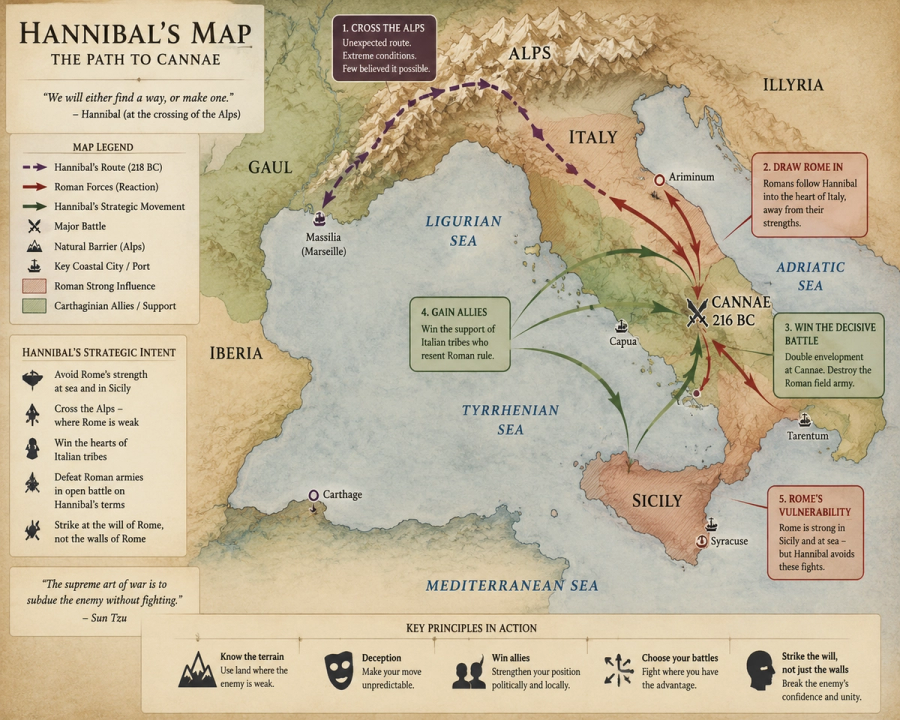
Hannibal the Great understood this at a level few commanders in history have matched. When he crossed the Alps with his army in 218 BC, it looked like recklessness to everyone who observed it, but it was not recklessness at all. It was precision. He bypassed Rome's strengths entirely, entered Italy from a direction no one anticipated, and then used Roman aggression against Rome itself at the Battle of Cannae, drawing their forces in, letting them overcommit, and destroying them through double envelopment. The boldness and the calculation were not opposites in his mind but the same move.
My friend believes he is channelling Sun Tzu, and in some ways he is, but Sun Tzu and Hannibal were not simply hungry. They were precise, and they were also, in the truest sense, positive: not blindly optimistic, but operating from a clear and deliberate model of the world that told them what was possible before anyone else could see it. Hunger was the fuel, and that model was the engine.
The Map You Are Already Using
My friend dismisses the idea that each of us operates from an internal map of the world, thinking it is comfortable language for people with comfortable lives, but I have written about this before, and the mechanism is simpler and less comfortable than he might expect. Your results come from your behaviours. Your behaviours come from your state. Your state comes from your internal representation of the situation you are in, shaped by filters built long before you had any say in them. That is not a self-help concept, it is a description of how decisions actually get made, and Sun Tzu understood it two and a half thousand years before anyone gave it a name. (You can read more on that here.)
My friend also has a map, recognise it or not, which he has been using for years.
His map says: I am alone, nobody helps, only hunger works, the system is against me, and every man must fend for himself. Parts of that map are accurate, because the structural barriers are real, the loneliness of his position is real, and the system has in measurable ways not been designed with him in mind.
A map is only useful, though, if it shows the full terrain, and a map that records every obstacle but marks no routes through them, no allies on the road, no resources already in your possession, is a map that will exhaust you before the terrain does.
There is also something his map may be doing that he has not yet fully accounted for. When a boat capsizes and a man is flapping in the water, panicking and screaming, the friend on a small raft may hesitate to reach out, not out of cruelty but out of self-preservation, fearing he will be pulled under alongside the person he is trying to help. The friend with the bigger raft will be far more comfortable extending a hand. My friend believes that nobody gives a damn, and he is not entirely wrong, because people do put themselves first, predominantly and naturally. But the degree to which they extend themselves toward you is shaped in part by what they see when they look at you. A man thrashing in desperation signals danger. A man moving with calm intent, even under extreme pressure, signals someone worth reaching for. The calm is not weakness. In a fight, the calm is operational.
Hannibal the Great understood this with complete clarity. His greatest asset at Cannae alongside his own brilliance was the coordination of his forces, his Numidian cavalry holding the flanks, his infantry at the centre absorbing the Roman push, his command reading the whole field with composure while the battle raged around him. The man who believes no one helps may be the man least positioned to use the allies already within reach, and in a fight that demands everything, that is a resource he cannot afford to leave on the table.
My friend is not arguing against having a map but maybe does not recognise he is using a fixed map in shifting terrain. Sun Tzu would recognise this immediately. Know yourself and know your enemy, he writes, and you need not fear the result of a hundred battles, but know yourself and not your enemy, and for every victory you will suffer a defeat. The enemy here is not only financial pressure but also the quality of the decisions made under that pressure, and those decisions flow directly from the map.
The Gap Between Pressure and Clarity
Pressure creates urgency, not clarity. Hunger creates movement, not direction.
A man fighting under pure survival pressure, with a map that tells him he is alone and that only rage will save him, may reject the ally he needs most, enter the wrong market and burn his remaining resources there, and confuse intensity with progress. Those three errors are a predictable output of a strategy built on hunger alone, and they have ended campaigns that began with every advantage.
Hannibal the Great did not win at Cannae because he was desperate. He won because he understood the terrain, studied the enemy, positioned his forces with precision, and waited for exactly the right moment to commit fully, with the hunger providing the will and the strategy providing the outcome. One without the other would have produced a very different battle.
Strategic Hunger
There is a third way forward, and it has nothing to do with optimism.
It asks three questions.
What do I actually want to achieve, not what am I running from but what am I moving toward?
What do I already have that I am not fully using, in skills, experience, knowledge, relationships, and time?
What is the single best next move available to me right now?
I believe it is much more powerful when a man stops reacting to what is behind him and starts deciding what is in front of him, where the whole quality of the fight changes. It is not inspiration. It is the point at which urgency becomes direction, and the man who was cornered becomes the man who is moving with intent. Hannibal the Great reached that moment before Cannae, and Sun Tzu built an entire philosophy around it. Neither man was simply positive, but both were precise, and that precision is what turns hunger into strategy.
For My Friend
He told me he has nothing to lose, and I want to offer him a different way to hold that.
Having nothing to lose is a freedom state, because the man with no position to protect can move in ways that others cannot, take risks that others will not, and commit fully in the knowledge that there is no retreat worth defending. Used deliberately, that is one of the cleanest and most powerful strategic advantages available to anyone entering a fight.
The entrepreneurial path he keeps returning to is not ambition in the conventional sense. For a man whose ceiling in employment has been quietly lowered, building something of his own is the logical response to a system that placed a wall where there should have been open sky.
That path demands hunger, and it also demands a map, a strategy, and the discipline to distinguish the battles that move him forward from the battles that only feel satisfying, because those are different battles, and choosing between them is the real work.
When your back is against the wall, hunger may make you stand up, but the thing that gets you out is not rage. It is the quality of the next decision.
Ask yourself one question today: Am I being driven by hunger, or directed by strategy?
Share this essay