Think Differently
What Are You Looking At?
A practical reflection on mental health, self-talk and the lens we choose to look through. This piece explores how changing our internal representation can shift our emotional state, behaviour and sense of control.
Maybe the most important mental health question this week is not how you feel, It is how you are choosing to see.
I am writing this from a sofa, leg elevated, having spent the last week being forced to do exactly what I am describing. Mental Health Awareness Week arrives every year with good intentions. The statistics get shared, the conversations get started, and people are encouraged to speak up. All of that matters. But awareness without something practical to hold onto is difficult to act on, and action is where things actually change.
So here is something practical.
Your State Is Not Your Situation
Most mental health struggles are not simply the result of what is happening around you. They are the result of how your internal world is processing what is happening around you. There is a meaningful difference between the two, and that difference is where your power lives.
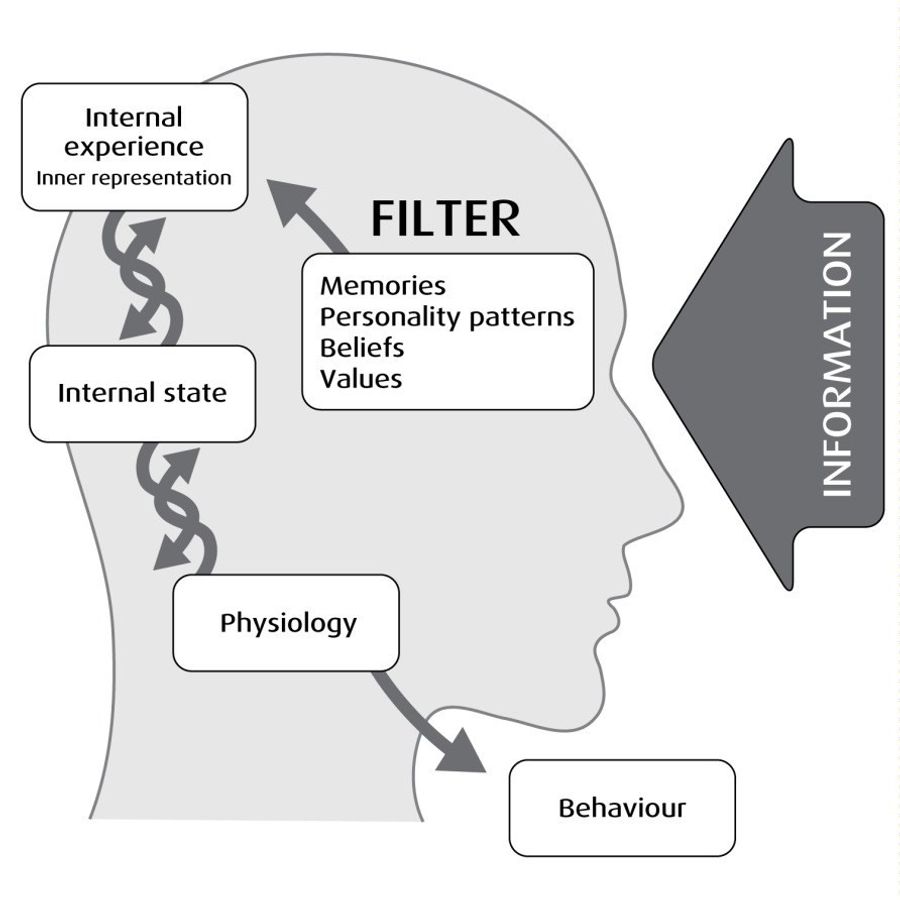
Think of it this way. Your results in life broadly come from your behaviours. Your behaviours come from your emotional state: if you are happy you will probably behave differently than if you are enraged. Your state comes from your internal representation, the images, words, memories and meanings your mind is constructing about your situation right now.
But here is the part most people miss. Before any of that even happens, every experience you have passes through a set of internal filters: your values, your beliefs, your memories, your social and cultural conditioning, and the meaning systems you have built up over a lifetime. These filters shape what you notice, what you delete, and what meaning you assign before you are even consciously aware of it. The same event can produce entirely different internal representations in two different people, because they are running it through entirely different filters.
Change the representation and you change the state. Change the state and the behaviours follow. The results take care of themselves. You did not choose most of your original programming. The environment you grew up in, the experiences that shaped you, the self-talk that plays on repeat, none of that arrived with your permission. But here is what is also true: you can become aware of it. And awareness is not a small thing. Awareness is the moment the autopilot hands back the controls.
The Lens You Are Looking Through
Self-talk is relentless. It runs commentary on everything, and when the commentary turns negative it has a way of becoming the only channel available. The mind starts filtering for evidence that confirms what it already believes, and before long the picture it is building looks like the whole truth.
It is not the whole truth. It is a view. And every view can be questioned.
Is the interpretation I am giving this situation the only one available? Usually it is not. Usually there is an alternative view that is equally valid and considerably kinder, and the only reason it is not the dominant one is that nobody has deliberately chosen it yet.
This is not about toxic positivity or pretending that difficult things are not difficult. It is about asking one honest question and sitting with the answer. Choose the alternative view deliberately. That single act is a mental health intervention available to you at any moment, at no cost, with no waiting list.
Slow Down. Look at What You Have.
One of the fastest ways to shift your internal state is also one of the most underestimated. Stop. Look at what is actually present in your life right now, not what is missing, not what went wrong, not what could still fall apart, but what is here, today, that you would genuinely miss if it were gone.
The people who show up. The small moments that go unnoticed because the mind is already somewhere else. The fact that you are reading this, which means you are still in the game. Joy does not always arrive as a grand event. More often it is hiding in plain sight, waiting for you to slow down enough to see it.
Gratitude is not a soft idea. It is a state-changer. When you focus on what you have rather than what you lack, you are not being naive about your circumstances. You are actively choosing the internal representation that serves you better. Your state follows your focus. Point it somewhere worth pointing.
You Are Not Your Programming
The thing that gets lost in most awareness conversations is this: struggling is not a character flaw. It is often the entirely predictable output of a set of internal representations that were installed long before you had any say in the matter.
You may simply be running an old programme on new circumstances and wondering why the results do not match what you want. The answer is not to push harder through the same loop. It is to become curious about the programme itself.
What story is your self-talk telling? Where did that story come from? Is it still serving you? These are not questions reserved for a crisis. They are the everyday maintenance that most people skip until something forces them to stop. You do not have to wait to be forced.
Mental Health Awareness Week is a prompt. What you do with the prompt is the part that counts. Slow down this week. Question the view. Look at what you have. And if the self-talk is running something that no longer serves you, remember: you did not write that programme, but you are the one who gets to decide whether to keep running it.
One awareness at a time.
If you found that useful, please share with someone else.
Share this essay