Think Differently
Identity: Assigned, Conditioned or Chosen?
This is a revised, shorter version of the original essay, The Self You Didn't Choose. This piece draws on Western psychology, African philosophy and Buddhist thought to ask a better question than "Who am I?" — and what to do with the answer.
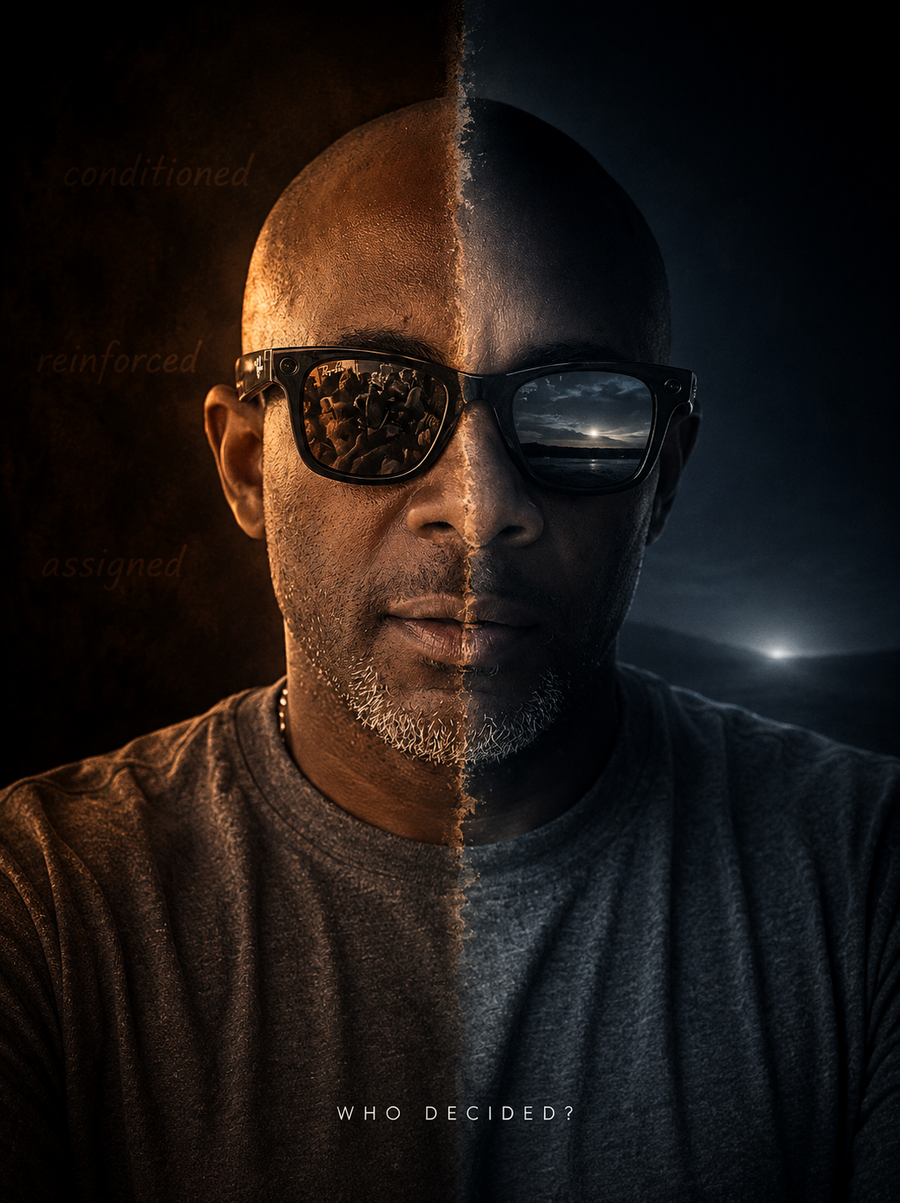
This is a revised, shorter version of the original essay, The Self You Didn't Choose.
We spend an extraordinary amount of time, money and emotional energy trying to find out who we really are, through therapy, retreats, journaling, personality tests and life coaches. The entire personal development industry is essentially one long answer to the same question, 'Who am I?'.
Nobody stops to ask whether the question is the right one. This question assumes there is a singular fixed answer sitting somewhere inside you, waiting to be excavated. But what if the more interesting question is "who decided who you are?" I think there is evidence, once you look for it properly, which suggests that a significant portion of what most people call their identity was never chosen at all. It was assigned to them, conditioned, absorbed and reinforced, often before they were old enough to push back on any of it.
The therapeutic instinct is to help people find themselves. Are they lost? The more useful instinct might be to help them notice how thoroughly they have already been found, by forces that had no particular interest in getting it right.
That said, this applies to many people but not all, and saying so upfront matters. Some people do consciously break their assigned identities and rebuild on their own terms. The more precise claim is that most people underestimate how much of what they call their identity was shaped before they had any real say in it.
Why This Matters
The same question shows up in very different ways for different people. It shows up in the teenage girl who moves between friendship groups, religions and identities so quickly that people around her lose count. From the outside it looks unstable. Look closer and it looks like someone searching desperately for somewhere to belong.
It shows up in the young man who gravitates towards peers whose identity centres on crime and antisocial behaviour. What began as belonging to a group gradually becomes his identity, shaped as much by a racist system that had already decided what kind of person he was going to be as by any choice he consciously made.
It shows up in the married man in his forties who cannot work out why every argument with his wife leaves him feeling like he is fighting for his life. He is defending an identity he stopped questioning decades earlier, and the argument is rarely about what it appears to be about.
Very different people, very different circumstances, and underneath all of it the same question. Does your identity only get built in adolescence, or does the same foundation get tested and rebuilt right through adult life?
The Panel
Come on now, "Who am I" is too wide a question to be useful. Better still is "Who shaped my identity, and when? Which parts did I consciously choose, and which didn't I? Can any of it be changed?"
What follows draws on western, eastern and african psychology, and philosophical tradition. They sit alongside each other rather than in order of authority.
One thing is worth saying plainly before we start. The Western psychological tradition was built largely by white men from the Global North studying populations that looked like them. That shapes what it sees and what it misses. Frantz Fanon, the Martinican psychiatrist and philosopher, spent his career on the question those theorists never asked, what happens to identity when a colonial system assigns you one before you are born, and then spends your entire life enforcing it? Where Erikson and Rogers ask how identity forms, Fanon asks what happens when the forming is done to you by a system with no interest in your flourishing. His work sits alongside the Western voices here, not behind them.
What the Theories Tell Us
Erikson argued that identity becomes the central psychological task of adolescence, the stage where a person pulls together values, experience and feedback into something coherent. Succeed and you develop fidelity, the capacity to commit. Struggle, and you are left with role confusion that can resurface as instability well into adulthood. Marcia extended this, showing that people move between exploration and commitment throughout life. A marriage breakdown in your forties is often one partner re-entering a questioning of identity they foreclosed on decades earlier without ever really choosing it.
Skinner argued that identity is less discovered than installed, behaviour by behaviour, through consistent reinforcement from the environment around you. His question is worth sitting with. How much of who you think you are is actually learned behaviour, reinforced so consistently it now feels unchangeable? His account leaves too little room for agency, and that is where he overreaches. Both the young man and the young woman in the opening still chose which rewards to chase, even within systems designed to narrow those choices.
Fanon went further than Skinner and in a different direction entirely. Where Skinner argues that identity is installed through reinforcement, Fanon argued that for people living under colonial or racist systems, the installation happens before they are born. In Black Skin, White Masks he described being "overdetermined from without." A Black person does not construct an identity and then encounter the world's reaction to it. They encounter the world's verdict first, and are left to build an identity from inside it. The young man in the opening was not rewarded into a "rude boy" identity. A racist system had already decided what kind of person he was before he had done anything to confirm it. Every interaction that followed, with police, with teachers, with institutions, reinforced a label he did not choose and could not easily refuse. Skinner describes conditioning. Fanon describes something heavier, a pre-assigned identity that shapes how every subsequent experience gets interpreted, including the young man's interpretation of himself. The question Fanon leaves us with is not whether identity can change, but how much harder that change is when the system around you keeps insisting on the original verdict.
Rogers offered something Skinner's account leaves out entirely, an inner life. He believed every person has an authentic self, and that the central task is stopping other people's expectations from burying it. Children who receive unconditional positive regard grow up free to explore who they actually are. When regard is conditional, children learn which parts of themselves are acceptable and suppress the rest to keep the love coming. Years of that produces an adult whose sense of self was built to gain approval rather than express who they actually are.
Buddhist philosophy questions an assumption all four Western thinkers share, that somewhere there is a real, continuous self to find. The doctrine of anatta, or non-self, holds that what we experience as a stable "me" is a constantly shifting bundle of sensations, feelings and thoughts, more like a flame than a fixed object. The suffering people feel around identity comes from treating something as fixed when it never was. An identity built from conditions can be rebuilt by changing the conditions, and the person doing the rebuilding is never only a product of what was done to them.
Ubuntu, the African philosophical tradition most associated with the phrase "I am because we are," dissolves the question in a different direction entirely. Archbishop Desmond Tutu described a person with Ubuntu as someone enlarged whenever someone else flourishes and diminished whenever someone else is humiliated. Mogobe Ramose argued that being itself is anchored in relationship rather than in the isolated individual Western philosophy takes for granted. Identity, in this view, exists between people rather than inside one person. The question Ubuntu asks of the teenager, the young man, and the man in his forties is what community failed to give them genuine belonging, and what system worked to withhold it.
Identity as Something You Practise
Each view explains how identity is searched for, built, defended or never fixed at all. None of them, on its own, fully explains how it changes.
Identity is something you continually reinforce, through every thought, decision and habit, every promise kept and broken, every person you spend time with, every standard you tolerate in yourself and others. Each one strengthens or weakens the story you tell yourself about who you are. This is why trying to change behaviour without examining identity tends to produce only temporary results.
Aristotle is commonly paraphrased as saying we are what we repeatedly do. Identity behaves less like a noun and more like a verb, something you do, over and over, until doing it stops feeling like a choice and starts feeling like who you are.
Who Are You Becoming?
If you recognise yourself in any of these stories, this is written with empathy rather than judgement. Finding a stable sense of who you are is genuinely hard, harder still when the world around you has already decided who it thinks you are.
If you are moving between identities looking for the one that finally fits, with awareness and a plan, you are doing the actual work.
If you have spent years inside an identity you never quite chose, you are not stuck with the version of yourself that other people's conditions produced. Identity follows the environment. Change the environment and the identity follows.
And if you are a grown man (or woman) wondering why your marriage feels like a constant fight, maybe the fight is not what it appears to be about. It could be about an identity you built decades ago and never went back to question, now under pressure from someone who loves you enough to push against it.
Identity is powerful and it stays open to change. Our past influences us, and can do so without imprisoning us. There are options, even when none feel obvious from where you are standing.
Perhaps the most important question we can ask a young person, or ourselves, is no longer "Who am I?" Perhaps it is simply this. Who are you becoming? Because the identity we practise today has a way of becoming the life we are living tomorrow.
Share this essay