Think Differently
Our Hero but Not One of Us
Every World Cup, the same question resurfaces. Who actually gets to be English, and who is only ever lent the shirt until the football stops going their way.
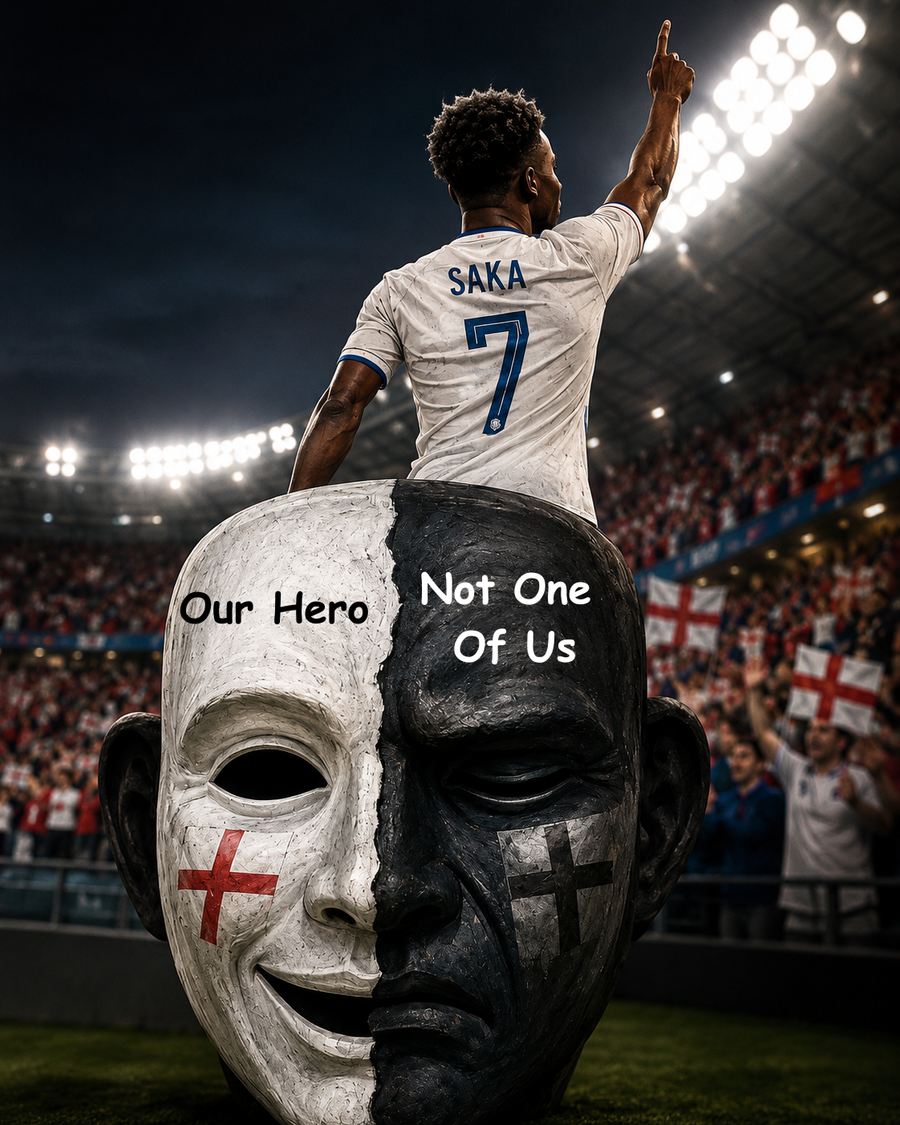
Every World Cup, the flags come out. In England, the St George's Cross appears in windows and on cars, and pubs fill with supporters. But since last year the flag itself has become the argument before a ball was even kicked. Oxfordshire Council tried to ban England flags from lampposts, citing fear and intimidation, and the response split almost exactly down the middle. A national poll found just under a third saw the flags as pride, just over half saw division, and the rest said it depends on context. Some readers said the far right had hijacked the flag of St George. Others said decent people were being told they couldn't fly their own country's colours.
For a few weeks every four years, millions of people in England from different creeds unite behind a 26 man squad, eleven wearing an England shirt with a three lions crest on the breast to play the beautiful game. Yet the same question resurfaces every tournament, usually once the unity has worn thin. Who actually has the right to wear that shirt, when the only criteria that should matter is skill and effort on the pitch?
Recently, I came across a street interview circulating on social media. The interviewer was asking members of the public about English identity and football. One man argued that players such as Bukayo Saka were not really English, and suggested that foreign ownership of English football clubs by Americans and Arabs was part of the same wider problem.
The comments section exploded. One side screamed racism, the other screamed patriotism, and both talked past one another.
There are legitimate discussions to be had about national identity, immigration, globalisation, and whether local communities have lost control of institutions that once represented them. Reasonable people can disagree on all of those questions. But that is not what interested me. What interested me was the mindset, because whenever these discussions emerge, the same assumptions and the same contradictions appear.
Take Bukayo Saka. Born in London, raised in England, educated in England, he represents and scores for England. Yet some people insist he is not really English because his parents are Nigerian.
Harry Kane's family comes from Ireland. Declan Rice has Irish ancestry. Jack Grealish has three Irish grandparents and represented Ireland at youth level. Wayne Rooney and Paul Scholes both have Irish ancestry, and Harry Maguire qualifies for Ireland through his grandparents. Yet nobody seems to challenge their Englishness.
So my question is, what exactly is the rule. If ancestry matters, it must matter for everyone. If birthplace, upbringing, culture and loyalty matter, they must matter for everyone. The moment the standard changes depending on the individual being judged, we are no longer dealing with principle. We are then dealing with prejudice.
After years of observing these arguments, I have noticed recurring traits. The first is intellectual inconsistency (II) dressed up as conviction. II cannot survive without double standards, demanding consistency from others while abandoning it itself. If Irish ancestry does not disqualify Harry Kane from being English, why would Nigerian ancestry disqualify Bukayo Saka? The answer is that many have simply stopped being curious. They see skin colour and believe they already know the person, skipping the investigation and jumping straight to the verdict, then applying whatever rule justifies the conclusion they'd already reached. A closed mind feels like certainty because it never has to wrestle with inconvenient facts.
The next is fear disguised as patriotism. Much of racism is rooted in fear, the fear of change, fear of difference, fear of losing status, fear of a future that looks different from the past. These fears are often wrapped in words such as culture, heritage and tradition, and sometimes those concerns are legitimate, raised by people with no prejudice in them at all. But fear becomes prejudice when another person's existence is treated as a threat before their character has even been assessed.
I have lived on both sides of that threat without ever crossing a border. Growing up in England, I was made to feel foreign at school, asked where I was "really" from before I'd finished a sentence. But when spending time in Barbados, where my parents are from, and the verdict flips entirely. There, I am the English one, not Bajan enough, too far removed, shaped by a country that isn't supposed to be mine.
Who I am, and my identity isn't up to whoever's looking at me that day. It's mine to decide, and I prove it by how I live and what I build, not by waiting for someone on either side of that border to give me permission to belong.
So the question of who gets to belong isn't abstract to me. It's lived, and it's taught me that the fear driving this mindset says nothing about the person it's aimed at. It only measures how secure the person holding it actually feels. Confident people rarely feel threatened by the ancestry of footballers. Secure people do not spend their evenings worrying about where somebody's grandparents were born.
The next is bitterness disguised as pride. One of the most revealing things about racists is how little time they spend celebrating what they claim to love. Instead, much of their energy gets pulled toward resentment in who belongs, who does not, who is changing the country, who is not one of us. It is a worldview fuelled by grievance, and grievance has a habit of becoming addictive. Bitterness narrows perception, turning every conversation into a complaint and every difference into a problem.
The last is oversimplification disguised as common sense. The world, history, identity and human beings are all complicated. The mindset attempts to reduce all of that complexity into a single visible characteristic, as if skin colour were the answer to every question. But reducing complexity is not intelligence. It is the abandonment of intelligence. Believing you are seeing reality clearly often means you are seeing less of it, not more.
Here is the final irony. The racist often claims to be defending English identity, yet England itself is the product of centuries of migration and integration, from Romans and Saxons through to the Irish, Europeans and Commonwealth citizens who followed. The history they claim to defend undermines the certainty of their position.
The greatest weakness of racism is that it is intellectually fragile. It depends on double standards, selective evidence, fear and resentment, and it struggles to survive sustained scrutiny.
The England football team simply exposes the contradiction. He is our hero the moment the ball hits the net, and not one of us the moment it doesn't. Nothing about the player changed. Only the result did.
I think it simply comes down to colour. Strip away the inconsistency, the fear, the bitterness, the excuses, and that's what's left underneath. So why can't they just call a spade a spade and be done with it?
Share this essay